
How We Use Industrial Dehumidifiers and Air Movers to Dry Phoenix Homes
When water damage strikes a Phoenix home — whether from a burst pipe, monsoon flooding, or an appliance leak — the most dangerous phase isn't the initial flood. It's what happens in the hours and days after the water is removed. Moisture that lingers inside walls, under flooring, and in structural cavities creates ideal conditions for mold growth, wood rot, and long-term structural deterioration. That's why professional dehumidification-drying">dehumidification and drying is the backbone of effective water damage restoration.
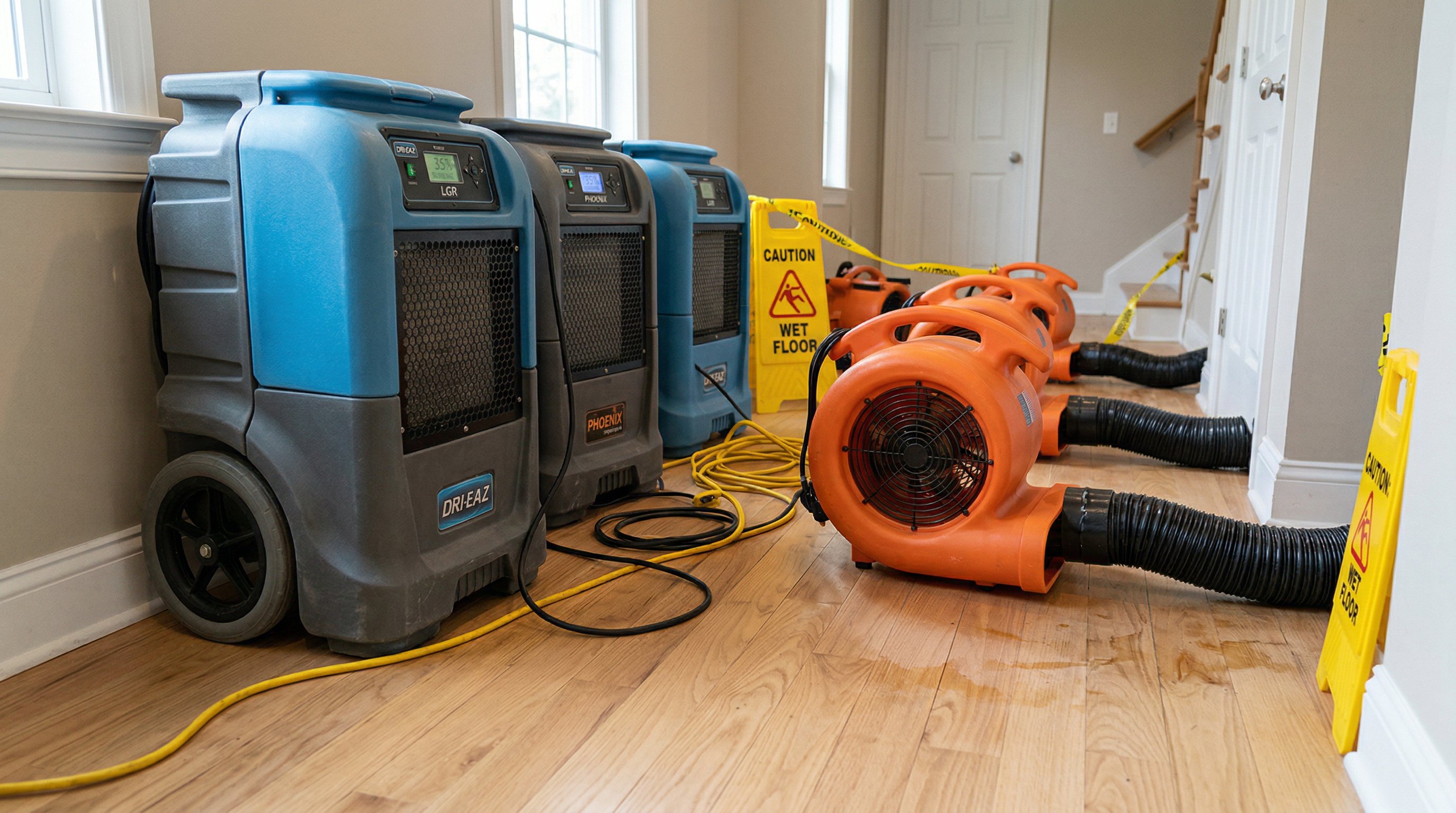
At Phoenix Water Damage Restoration, we use professional-grade industrial dehumidifiers and high-velocity air movers as the core of our drying process. These are not consumer-grade fans or rental store dehumidifiers — they are commercial restoration equipment designed to remove massive quantities of moisture from structural materials quickly and systematically. Here's exactly how the process works and why it makes such a critical difference for Phoenix homeowners.
Why Thorough Drying Is Non-Negotiable After Water Damage
Many homeowners assume that once visible water is cleaned up, the hard part is over. In reality, it's just beginning. Water is remarkably adept at infiltrating porous materials: it wicks into drywall, soaks into wood subfloor, travels along insulation, and migrates into wall cavities through the smallest gaps. Once inside these materials, moisture is invisible to the naked eye — but it continues doing damage.
The Mold Risk in Phoenix
Mold can begin colonizing wet materials within 24 to 48 hours of water exposure — even in Phoenix's normally dry climate. During monsoon season, when outdoor humidity rises significantly, the risk accelerates. Without thorough structural drying, a flooded bathroom or water-damaged kitchen can develop a hidden mold problem inside the walls within just a few days. Read more about how fast mold grows after water damage in Phoenix on our blog.
Secondary Structural Damage
Moisture that remains in wood framing and subfloor causes the wood to swell, warp, and eventually rot. Drywall that doesn't fully dry will become soft, lose structural integrity, and require complete replacement. Flooring — whether hardwood, laminate, or engineered wood — buckles and separates when moisture is trapped beneath it. Proper drying is far less expensive than reconstruction.
Phoenix's Unique Drying Environment
Phoenix's desert climate creates an interesting paradox for water damage restoration. On one hand, the low ambient humidity during most of the year is helpful — dry outdoor air provides a natural moisture sink. On the other hand, during monsoon season (June through September), outdoor humidity can spike dramatically, reducing or eliminating that advantage. Professional equipment performs consistently regardless of outdoor conditions, which is why it outperforms simply "opening windows" even in Arizona's desert air.
What Are Industrial Dehumidifiers?
Industrial dehumidifiers — also called Low Grain Refrigerant (LGR) dehumidifiers — are purpose-built for structural drying. They bear almost no resemblance to the consumer dehumidifiers available at hardware stores.
How They Work
Industrial dehumidifiers pull moisture-laden air across refrigerated coils, causing the water vapor to condense into liquid water, which is then drained away. The dried air is reheated and discharged back into the room, where it can absorb more moisture from wet materials. This cycle runs continuously, progressively lowering the humidity of the air in the affected space.
LGR Technology
Low Grain Refrigerant (LGR) dehumidifiers are the industry standard for professional restoration. They can reduce air moisture levels to as low as 20–30 grains per pound of air (compared to typical indoor air at 50–80 grains), creating an extremely dry environment that pulls moisture aggressively out of structural materials. Standard dehumidifiers can only reduce humidity to about 40 grains per pound — not sufficient for effective structural drying.
Capacity
A typical LGR dehumidifier used in professional restoration can remove 150 to 200 pints of water per day from the air — vastly more than a consumer unit, which typically removes 30 to 50 pints per day. For large water damage jobs in Phoenix homes, we may deploy multiple industrial units simultaneously.
What Are High-Velocity Air Movers?
Air movers — sometimes called axial fans or carpet dryers — are the second essential component of professional structural drying. They look like squat, low-profile fans designed to direct a concentrated stream of high-velocity air across wet surfaces.
How They Work
Air movers accelerate evaporation at the surface of wet materials. When air moves rapidly across a wet surface, it picks up water vapor far more efficiently than still or gently moving air. This is the same principle as blowing on a spoonful of hot soup to cool it — the moving air accelerates evaporation (and in the case of soup, heat transfer). By directing high-velocity airflow across wet flooring, walls, and ceilings, air movers dramatically increase the rate at which moisture evaporates from those surfaces into the air.
The Partnership with Dehumidifiers
Air movers and dehumidifiers work as a system. Air movers cause moisture to evaporate rapidly from materials into the air. If the room's air were not also being dried by dehumidifiers, the air would quickly become saturated and evaporation would stop. Dehumidifiers continuously remove that moisture from the air, keeping the air dry enough to continue absorbing more moisture from materials. Together, the two types of equipment create a self-sustaining drying loop that is exponentially more effective than either type of equipment used alone.
How We Set Up the Drying System in Your Phoenix Home
Deploying drying equipment correctly requires professional training and experience. It's not simply a matter of placing fans and dehumidifiers in the flooded room. Our technicians follow a systematic process based on industry standards established by the Institute of Inspection, Cleaning and Restoration Certification (IICRC).
Step 1: Water Extraction First
Before any drying equipment is placed, our team performs thorough water extraction to remove all standing water. Attempting to dry a room that still has standing water is inefficient — the equipment is overwhelmed before structural drying can even begin. Truck-mounted extractors and portable units remove water from flooring, carpeting, and other surfaces.
Step 2: Moisture Mapping
Using professional moisture meters, thermal imaging cameras, and hygrometers, our technicians map the full extent of moisture migration throughout the affected area. This step identifies every wet wall cavity, subfloor section, and ceiling space that needs to be dried — not just the areas with visible water damage. Moisture mapping ensures that drying equipment is placed strategically to address every affected area.
Step 3: Equipment Placement
Based on the moisture map, technicians calculate the drying system requirements using IICRC S500 standards, which account for the volume of the affected space, the types of materials present, and the degree of saturation. Air movers are positioned at the base of wet walls and across wet flooring to direct high-velocity airflow across surfaces. Dehumidifiers are placed to capture the moisture-laden air being produced by the air movers.
Typical Placement Ratios
As a general guideline, restoration professionals use approximately one air mover for every 10 to 16 square feet of wet flooring or wall surface, paired with industrial dehumidifiers sized to handle the total volume of the drying system. In practice, a water-damaged kitchen or bathroom in a Phoenix home might require 8 to 15 air movers and 1 to 3 dehumidifiers running simultaneously.
Step 4: Injected Air Drying for Wall Cavities
Standard air movers work on exposed surfaces, but what about moisture trapped inside wall cavities? For wet wall interiors, we use a technique called injected air drying. Small holes are drilled in the drywall at regular intervals, and specialized attachments are fitted to air movers to direct airflow directly inside the wall cavity, drying the interior surfaces and insulation from the inside out. In many cases, this technique allows wet walls to be dried without full drywall removal — saving significant reconstruction costs.
Step 5: Daily Monitoring
Drying is not a set-it-and-forget-it process. Our technicians return daily to take moisture readings throughout the affected area, log the readings in a drying report, and adjust equipment placement as needed. As different materials dry at different rates, air movers may be repositioned to focus on areas that are drying more slowly. This documentation also serves as an essential record for your insurance claim.
Step 6: Clearance Testing
Drying is complete when all affected materials have reached their dry standard moisture content levels — the moisture content they had before the water damage occurred. This is determined through moisture meter readings, not by how the materials look or feel. Premature removal of equipment is one of the most common mistakes in DIY restoration and leads to mold problems weeks later. Our technicians provide a signed clearance report when drying is complete.
Specialty Drying Challenges in Phoenix Homes
Hardwood and Engineered Wood Flooring
Hardwood and engineered wood floors are among the most challenging materials to dry. These floors are highly susceptible to cupping, buckling, and warping when wet. Our technicians use specialized floor drying mats — sealed systems that direct conditioned air under flooring — in combination with standard air movers to dry hardwood floors from both above and below simultaneously. In many Phoenix homes, this approach saves hardwood floors that might otherwise require complete replacement.
Concrete Slab Foundations
Phoenix homes are commonly built on concrete slab foundations, which present a unique drying challenge. Concrete is porous and can absorb significant amounts of water. When flooring installed over a slab gets wet, moisture can be trapped between the flooring and the slab, creating long-term moisture problems. Our drying protocols for slab-on-grade structures account for concrete drying times, which are longer than wood.
Drywall and Insulation
Standard fiberglass batt insulation does not dry effectively — once thoroughly saturated, it must typically be removed. However, drywall can often be dried in place if caught early, using the injected air drying technique described above. Our goal is always to maximize material salvage through effective drying to minimize your reconstruction costs.
How Long Does Structural Drying Take in Phoenix?
Most residential structural drying projects in Phoenix take between 3 and 5 days with proper equipment deployment. Several factors affect the timeline:
- Severity of saturation: Materials that have been wet for longer periods absorb more moisture and take longer to dry.
- Type of materials: Porous materials like wood and drywall dry faster than dense materials like concrete. Carpet padding typically must be replaced rather than dried.
- Scope of affected area: Larger affected areas require more equipment and more time.
- Ambient conditions: During Phoenix monsoon season, higher outdoor humidity can extend drying times slightly, though professional equipment compensates for this.
Our team provides an estimated drying timeline during the initial assessment and updates it daily based on moisture readings. To understand the full restoration process timeline, read our guide on what to do after water damage in Phoenix.
Why Consumer Equipment Isn't Enough
Homeowners sometimes attempt to dry water-damaged areas using box fans and rental store dehumidifiers. While this is understandable, it is rarely effective for true structural drying. Consumer-grade equipment simply lacks the capacity to dry structural materials at the rate needed to prevent mold growth. A box fan moves air, but not at the velocity needed to accelerate evaporation from structural materials. A consumer dehumidifier removes moisture from room air, but cannot achieve the low grain readings needed to pull moisture from saturated drywall or subfloor. The result is a home that looks dry on the surface while remaining wet inside the structure — setting the stage for mold growth, odors, and structural damage that becomes evident weeks later. Professional water damage restoration is almost always less expensive in the long run than dealing with the consequences of inadequate drying.
Frequently Asked Questions About Dehumidification and Drying
Is the drying equipment very loud? Will it disrupt my household?
Industrial air movers and dehumidifiers do produce significant noise — similar to a running dishwasher or window air conditioner, but louder when multiple units are operating simultaneously. Many Phoenix homeowners choose to stay elsewhere during the drying period, particularly if multiple rooms are affected. Our team can discuss logistics with you during the initial assessment.
Can I turn off the drying equipment at night to sleep?
We strongly advise against turning off drying equipment during the process. Drying is most effective when continuous, and interrupting the process allows humidity levels to rise, slowing overall progress and potentially allowing mold conditions to develop. Each interruption can add a day or more to the total drying timeline.
How do I know when drying is complete?
Drying is confirmed by moisture meter readings, not by visual appearance. Our technicians take readings daily and document them in a drying log. When all affected materials reach their pre-loss moisture content levels, drying is declared complete and the equipment is removed.
Will my homeowner's insurance cover the cost of drying equipment and labor?
Most standard homeowner's insurance policies in Arizona cover water damage restoration costs including professional drying services for sudden and accidental water losses. Coverage for gradual leaks varies by policy. Check your specific policy and contact your insurance agent promptly after any water damage event. For more information, read our blog post on whether insurance covers water damage in Phoenix.
Do you use thermal imaging during the drying process?
Yes. Thermal imaging is a key tool in our moisture mapping and monitoring process. Infrared cameras reveal temperature differences in walls and ceilings that indicate moisture presence, allowing us to identify wet areas that cannot be detected with visual inspection alone.
Trust Professional Drying for Your Phoenix Home
Industrial dehumidifiers and air movers aren't just equipment — they're the difference between a home that recovers fully from water damage and one that develops hidden mold, structural damage, and persistent odors for years to come. At Phoenix Water Damage Restoration, our technicians are trained in the science of structural drying and deploy the right equipment, in the right configuration, monitored daily to ensure your home is thoroughly dried.
Phoenix Water Damage Restoration is a trusted choice for commercial & residential water damage restoration in Phoenix, AZ, delivering fast response times, expert drying, and full-service restoration.
Call Us 24/7: (623) 300-3108
Easy steps to create a color palette
Lorem ipsum dolor sit amet, consectetur adipiscing elit lobortis arcu enim urna adipiscing praesent velit viverra sit semper lorem eu cursus vel hendrerit elementum morbi curabitur etiam nibh justo, lorem aliquet donec sed sit mi dignissim at ante massa mattis.
- Neque sodales ut etiam sit amet nisl purus non tellus orci ac auctor
- Adipiscing elit ut aliquam purus sit amet viverra suspendisse potent
- Mauris commodo quis imperdiet massa tincidunt nunc pulvinar
- Excepteur sint occaecat cupidatat non proident sunt in culpa qui officia
What is a color palette?
Vitae congue eu consequat ac felis placerat vestibulum lectus mauris ultrices cursus sit amet dictum sit amet justo donec enim diam porttitor lacus luctus accumsan tortor posuere praesent tristique magna sit amet purus gravida quis blandit turpis.

Don’t overspend on growth marketing without good retention rates
At risus viverra adipiscing at in tellus integer feugiat nisl pretium fusce id velit ut tortor sagittis orci a scelerisque purus semper eget at lectus urna duis convallis porta nibh venenatis cras sed felis eget neque laoreet suspendisse interdum consectetur libero id faucibus nisl donec pretium vulputate sapien nec sagittis aliquam nunc lobortis mattis aliquam faucibus purus in.
- Neque sodales ut etiam sit amet nisl purus non tellus orci ac auctor
- Adipiscing elit ut aliquam purus sit amet viverra suspendisse potenti
- Mauris commodo quis imperdiet massa tincidunt nunc pulvinar
- Adipiscing elit ut aliquam purus sit amet viverra suspendisse potenti
What’s the ideal customer retention rate?
Nisi quis eleifend quam adipiscing vitae aliquet bibendum enim facilisis gravida neque euismod in pellentesque massa placerat volutpat lacus laoreet non curabitur gravida odio aenean sed adipiscing diam donec adipiscing tristique risus amet est placerat in egestas erat.
“Lorem ipsum dolor sit amet consectetur adipiscing elit, sed do eiusmod tempor incididunt ut labore et dolore magna aliqua enim ad minim veniam.”
Next steps to increase your customer retention
Eget lorem dolor sed viverra ipsum nunc aliquet bibendum felis donec et odio pellentesque diam volutpat commodo sed egestas aliquam sem fringilla ut morbi tincidunt augue interdum velit euismod eu tincidunt tortor aliquam nulla facilisi aenean sed adipiscing diam donec adipiscing ut lectus arcu bibendum at varius vel pharetra nibh venenatis cras sed felis eget.