
Category 1 vs. Category 2 vs. Category 3 Water Damage Explained
When water damage restoration professionals arrive at your Phoenix, AZ home, one of the first things they do is classify the water. This isn't a formality — the category of water contamination fundamentally shapes every subsequent decision in the restoration process: what personal protective equipment is required, which materials can be dried and saved versus which must be removed and discarded, what disinfection protocols are necessary, how the job is documented for insurance, and ultimately, what the restoration will cost.
The three-category classification system is established by the Institute of Inspection Cleaning and Restoration Certification (IICRC) in its S500 Standard for Professional Water Damage Restoration — the industry's definitive technical standard. Understanding these categories as a Phoenix homeowner gives you the context to make better decisions, ask better questions, and understand why restoration professionals make the recommendations they do.
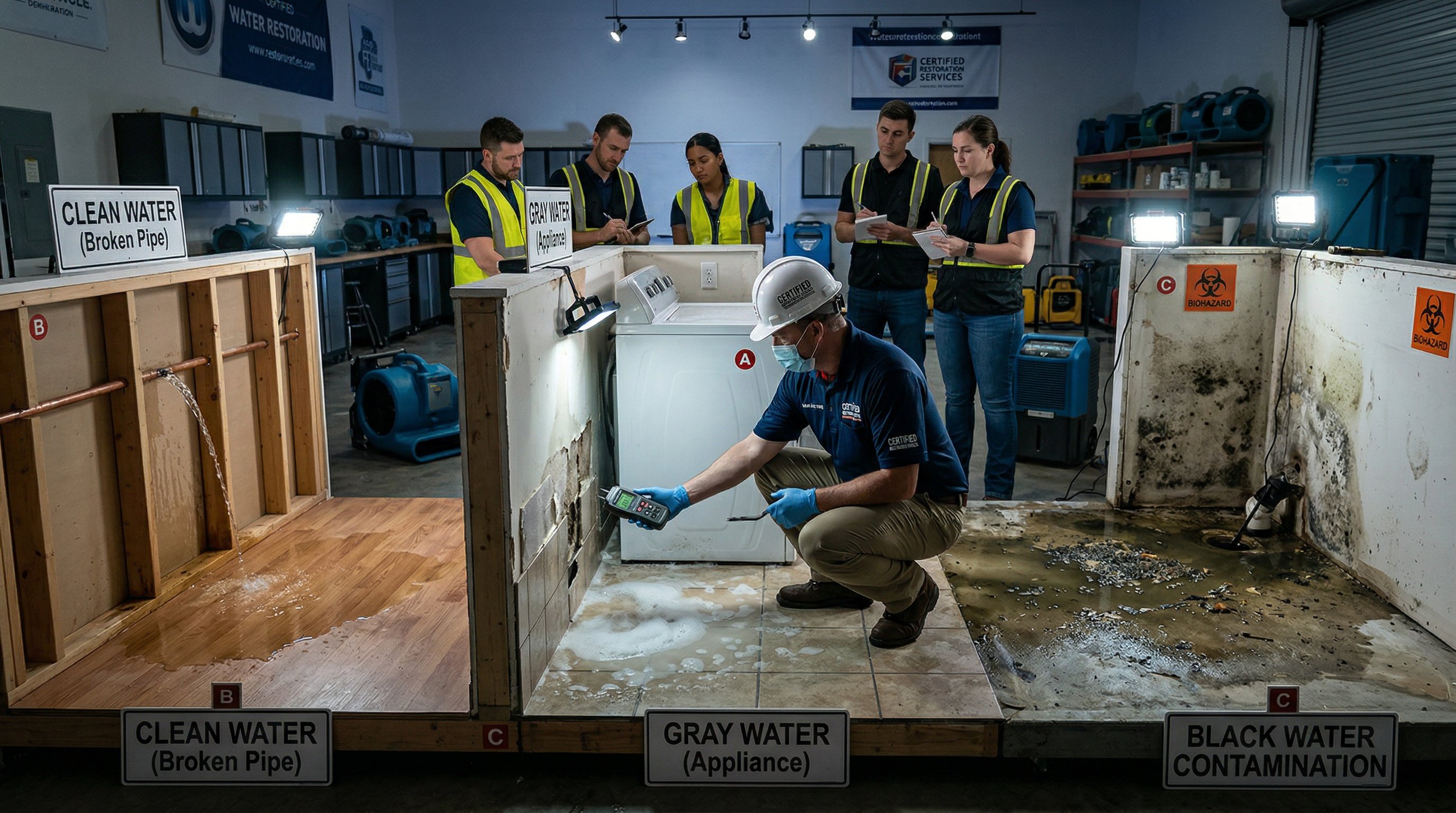
Category 1: Clean Water
What It Is
Category 1 water — often called "clean water" — originates from a sanitary source and does not pose a significant health risk upon exposure. Category 1 sources include:
- Broken clean water supply lines (the pipes that bring water into your home from the city main or well)
- Overflow from bathtubs or sinks from a running faucet (without contaminants)
- Appliance failures involving supply lines (washing machine fill hose, refrigerator ice maker line)
- Rainwater entering through a roof leak or damaged window before touching other surfaces
- Toilet tank overflows (not toilet bowl)
- Melted ice or snow
Restoration Approach for Category 1
Category 1 water damage is the most straightforward to remediate. Key characteristics of Category 1 restoration include:
- No specialized biohazard PPE required for restoration crews
- Porous materials (drywall, carpet, wood) that are wet but not heavily saturated may be dried in place if the drying process begins quickly
- Standard commercial dehumidifiers and air movers are sufficient for drying
- No disinfection of structural materials required (though antimicrobial treatment is still a best practice)
An important caveat: Category 1 water can degrade to Category 2 within 24–48 hours if it contacts contaminated surfaces or sits long enough for microbial growth to begin. In Phoenix's warm climate, this degradation can happen even faster. This means that even clean water damage requires prompt, professional response. Our water extraction team responds quickly to prevent category degradation.
Cost Range for Category 1 Restoration
Category 1 water damage is typically the least expensive to restore. For a single-room event caught promptly, costs typically range from $500–$4,000 depending on square footage and materials affected. Rapid response is the single most effective cost-control measure for Category 1 events.
Category 2: Gray Water
What It Is
Category 2 water — called "gray water" — contains significant contamination that can cause discomfort or illness upon human exposure. It may contain microorganisms as well as chemical, biological, or physical contaminants. Category 2 sources include:
- Dishwasher or washing machine overflow
- Toilet overflow with urine only (no feces)
- Aquarium leaks
- Hydrostatic pressure seepage through a slab or foundation
- Water that has traveled over or through certain surfaces and picked up contaminants
- Category 1 water that has degraded over time (approximately 24–72 hours after the initial event)
Restoration Approach for Category 2
Category 2 events require more protective measures and more thorough treatment than Category 1:
- Restoration crews wear appropriate PPE including gloves and sometimes eye protection
- Porous materials that have been in contact with Category 2 water require disinfection; heavily saturated materials typically must be removed
- Carpet and pad that has been contacted by Category 2 water is typically removed (the pad almost always; the carpet may be salvageable in some cases)
- All surfaces are treated with EPA-registered disinfectants after drying
- Indoor air quality considerations apply, as airborne contamination is possible
The critical concern with Category 2 is that it can quickly degrade to Category 3 — particularly if it contacts sewage drains or is left standing for more than 24–48 hours. In Phoenix's summer heat, this degradation happens faster than in cooler climates. Our water damage remediation team is trained to properly assess the current and potential category of any water event.
Cost Range for Category 2 Restoration
Category 2 events cost more than Category 1 due to the additional disinfection requirements, higher material removal rates, and more stringent documentation requirements. A typical single-room Category 2 event in Phoenix costs $1,500–$6,000 or more depending on materials and scope.
Category 3: Black Water
What It Is
Category 3 water — commonly called "black water" — is grossly contaminated and can contain pathogenic agents that can cause severe illness or death. Category 3 sources include:
- Sewage backup from any source
- Flooding from rivers, streams, or stormwater runoff (monsoon flooding)
- Ground surface water intrusion following heavy rainfall (which may contain pesticides, fertilizers, animal waste, and other contaminants)
- Toilet overflow with fecal matter
- Wind-driven rain that has contacted contaminated surfaces
- Category 1 or 2 water that has been left standing for 72+ hours
Monsoon floodwater in Phoenix is almost always classified as Category 3. Even if it enters your home as relatively clean rainwater, it quickly contacts soil, asphalt, and other contaminated surfaces before entering through doors, windows, or foundation cracks.
Restoration Approach for Category 3
Category 3 remediation is the most comprehensive and technically demanding category of water damage restoration:
- All restoration personnel wear full PPE: Tyvek suits, rubber boots, N95 or higher respirators, eye protection, and chemical-resistant gloves
- All porous materials that contacted Category 3 water must be removed, period. This includes carpet, carpet pad, drywall, insulation, and any other porous material — regardless of whether it appears dry or undamaged
- All hard, non-porous surfaces (concrete, tile, metal, glass) must be thoroughly cleaned and disinfected with EPA-registered biocides
- Negative air pressure containment is established to prevent cross-contamination to unaffected areas
- HEPA air filtration is deployed to capture airborne contaminants
- All removed materials are disposed of as contaminated waste according to local regulations
Our contaminated water cleanup and sewage backup cleanup teams follow full Category 3 protocols for all grossly contaminated water events. For more detail on the dangers of black water, see our post on black water damage and health risks.
Cost Range for Category 3 Restoration
Category 3 restoration is the most expensive per-square-foot due to mandatory material removal, specialized PPE and disposal requirements, and extensive disinfection protocols. Typical Phoenix Category 3 events cost $3,000–$15,000+ for restoration, with sewage backup events at the higher end of the range and large-scale monsoon flooding potentially exceeding these figures significantly.
How Category Affects Insurance Coverage
The water damage category affects insurance in several important ways:
- Category 1: Most likely to be fully covered under a standard homeowner's policy if the source was sudden and accidental.
- Category 2: May be covered depending on the source. Appliance failures are often covered; seepage through foundations may not be.
- Category 3 from sewage backup: Typically excluded under standard policies — requires a sewer backup endorsement.
- Category 3 from monsoon flooding: Requires a separate flood insurance policy (NFIP or private).
For a comprehensive guide to insurance coverage for water damage in Phoenix, see our post on does insurance cover water damage in Phoenix.
Category Can Change: The Importance of Speed
One of the most important principles in water damage restoration is that water categories are not static — they change over time and through contact with new surfaces. Clean Category 1 water degrades to Category 2 within 24–72 hours as microorganisms begin to multiply. Category 2 becomes Category 3 as contamination increases further. In Phoenix's summer heat, these degradation timelines are compressed.
This means that the category of your water damage — and therefore the cost, complexity, and scope of restoration required — is directly influenced by how quickly you respond. Water that is Category 1 when the pipe bursts may be Category 2 by the next morning and Category 3 by the following day. Every hour of delay potentially upgrades the category and expands the scope of required remediation.
Read our detailed guide on what to do after water damage in Phoenix to understand the correct immediate response to any water event.
Q&A: Water Damage Categories in Phoenix
How do restoration professionals determine the water category on-site?
Professionals assess water category based on the identified source, how long the water has been present, what surfaces it has contacted, visual and olfactory assessment, and sometimes field testing. If the source cannot be definitively identified as clean, a conservative higher category is assigned — protecting the safety of both restoration crews and occupants.
Can Category 2 water become Category 1 if it's treated?
No. Once water has been contaminated, it cannot be "uncontaminated" to a cleaner category. Treatment (disinfection, extraction) addresses the contamination in materials and surfaces, but the water itself, and any materials it has already contacted, must be treated according to the higher category standards.
Is rain that enters through my roof Category 1 water?
Generally yes, if it enters as direct precipitation before contacting contaminated surfaces. However, rain that enters through a contaminated area (such as a bird-infested attic or a roof with heavy mold growth) may be classified higher. Your restoration team will assess the specific entry pathway and route the water traveled before classifying the event.
My basement flooded from monsoon runoff — is that Category 3?
Almost certainly yes. Stormwater and surface runoff are classified as Category 3 because they contact soil, streets, animal waste, and other contaminated surfaces before entering your home. All porous materials that contacted this water — carpet, drywall, insulation — must be removed as part of proper remediation.
Does the category determine whether I can stay in my home during restoration?
Partially. Category 3 events typically require more extensive material removal and disinfection that may make portions of the home uninhabitable during remediation. Category 1 events in a single room may allow you to remain in unaffected areas of the home. Your restoration team will advise on safety and habitability for your specific situation.
Know Your Category, Know Your Next Step
Understanding water damage categories gives you a framework for understanding why your restoration team makes the recommendations they do — and why it matters so much to respond quickly. Whether you're dealing with a clean supply line leak or a sewage backup from a monsoon-overwhelmed storm sewer, Phoenix Water Damage Restoration has the expertise and equipment to address it correctly.
Phoenix Water Damage Restoration is a trusted choice for commercial & residential water damage restoration in Phoenix, AZ, delivering fast response times, expert drying, and full-service restoration. Call Us 24/7: (623) 300-3108
Easy steps to create a color palette
Lorem ipsum dolor sit amet, consectetur adipiscing elit lobortis arcu enim urna adipiscing praesent velit viverra sit semper lorem eu cursus vel hendrerit elementum morbi curabitur etiam nibh justo, lorem aliquet donec sed sit mi dignissim at ante massa mattis.
- Neque sodales ut etiam sit amet nisl purus non tellus orci ac auctor
- Adipiscing elit ut aliquam purus sit amet viverra suspendisse potent
- Mauris commodo quis imperdiet massa tincidunt nunc pulvinar
- Excepteur sint occaecat cupidatat non proident sunt in culpa qui officia
What is a color palette?
Vitae congue eu consequat ac felis placerat vestibulum lectus mauris ultrices cursus sit amet dictum sit amet justo donec enim diam porttitor lacus luctus accumsan tortor posuere praesent tristique magna sit amet purus gravida quis blandit turpis.
Don’t overspend on growth marketing without good retention rates
At risus viverra adipiscing at in tellus integer feugiat nisl pretium fusce id velit ut tortor sagittis orci a scelerisque purus semper eget at lectus urna duis convallis porta nibh venenatis cras sed felis eget neque laoreet suspendisse interdum consectetur libero id faucibus nisl donec pretium vulputate sapien nec sagittis aliquam nunc lobortis mattis aliquam faucibus purus in.
- Neque sodales ut etiam sit amet nisl purus non tellus orci ac auctor
- Adipiscing elit ut aliquam purus sit amet viverra suspendisse potenti
- Mauris commodo quis imperdiet massa tincidunt nunc pulvinar
- Adipiscing elit ut aliquam purus sit amet viverra suspendisse potenti
What’s the ideal customer retention rate?
Nisi quis eleifend quam adipiscing vitae aliquet bibendum enim facilisis gravida neque euismod in pellentesque massa placerat volutpat lacus laoreet non curabitur gravida odio aenean sed adipiscing diam donec adipiscing tristique risus amet est placerat in egestas erat.
“Lorem ipsum dolor sit amet consectetur adipiscing elit, sed do eiusmod tempor incididunt ut labore et dolore magna aliqua enim ad minim veniam.”
Next steps to increase your customer retention
Eget lorem dolor sed viverra ipsum nunc aliquet bibendum felis donec et odio pellentesque diam volutpat commodo sed egestas aliquam sem fringilla ut morbi tincidunt augue interdum velit euismod eu tincidunt tortor aliquam nulla facilisi aenean sed adipiscing diam donec adipiscing ut lectus arcu bibendum at varius vel pharetra nibh venenatis cras sed felis eget.