
Water Damage Restoration vs. Water Mitigation: Understanding the Difference
If you've ever called a water damage company or filed an insurance claim after a flood or pipe burst in your Phoenix home, you've probably heard both terms: water damage restoration and water mitigation. Many homeowners use them interchangeably, but they actually describe two distinct phases of the water damage recovery process. Understanding the difference between water damage restoration and water mitigation isn't just a vocabulary exercise — it directly affects how you communicate with your insurance company, what services you request, and how you plan your recovery timeline.
This guide explains exactly what each term means, how the two services work together, and what Phoenix homeowners should expect from each phase of the process.
What Is Water Mitigation?
Water mitigation refers to the emergency, damage-limiting actions taken immediately after a water damage event. The word "mitigation" means to reduce the severity of something — and that's exactly what this phase is about. The goal of mitigation is to stop the damage from getting worse and stabilize the property as quickly as possible.
Think of water mitigation as the emergency room phase of water damage recovery. It doesn't fix everything — it stabilizes the patient and prevents the situation from becoming life-threatening.
What Does Water Mitigation Include?
The specific services that fall under water mitigation include:
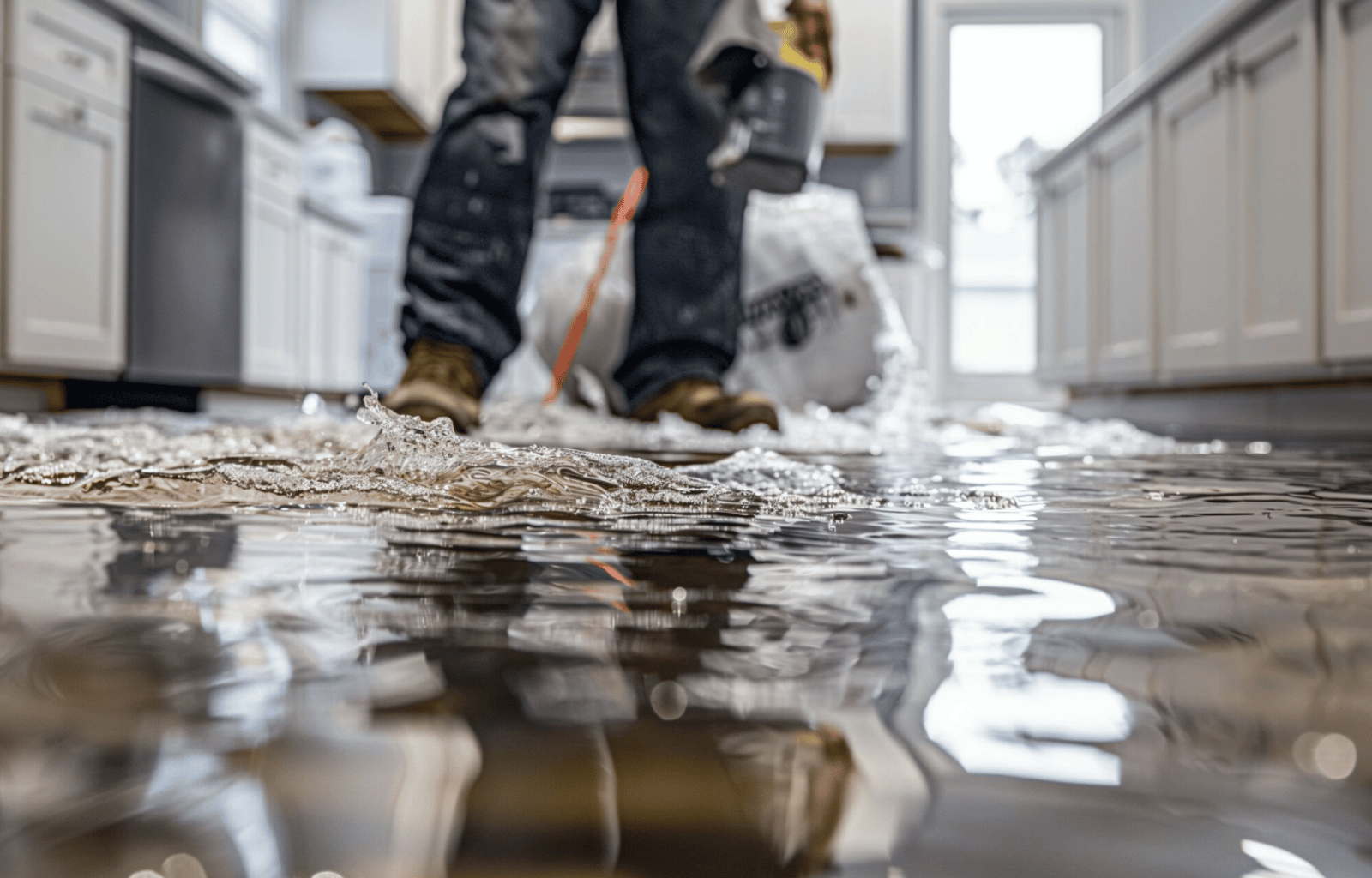
- Emergency water extraction: Removing standing water from the property using truck-mounted extractors and portable pumps. Fast water extraction is the most critical mitigation step — every hour water sits, it migrates deeper into structural materials and increases total damage.
- Source control: Identifying and stopping the water source, whether that means shutting off a supply valve, tarping a damaged roof, or coordinating with a plumber for a burst pipe repair.
- Content protection: Moving furniture, electronics, documents, and other personal property away from the water-affected area to prevent further damage to valuables.
- Antimicrobial application: Applying EPA-registered antimicrobial treatments to wet surfaces to inhibit mold growth during the drying and restoration process.
- Initial structural drying: Deploying industrial dehumidifiers and air movers to begin removing moisture from the structure and preventing conditions that would allow mold to proliferate.
- Structural stabilization: Addressing any immediate structural concerns that pose a safety risk, such as sagging ceiling sections or compromised floors.
- Documentation: Thoroughly photographing and documenting the damage to support the insurance claim process.
In short, mitigation is everything done to stop the bleeding and stabilize the property. It is reactive, immediate, and urgent.
When Does Mitigation End?
Mitigation is considered complete when:
- The water source has been stopped.
- All standing water has been removed.
- The structure and contents have been stabilized to prevent further damage.
- The drying process has been initiated.
At this point, the property has been stabilized — but it has not been restored to its pre-loss condition. That's where restoration begins. Learn more about our residential water damage mitigation services.
What Is Water Damage Restoration?
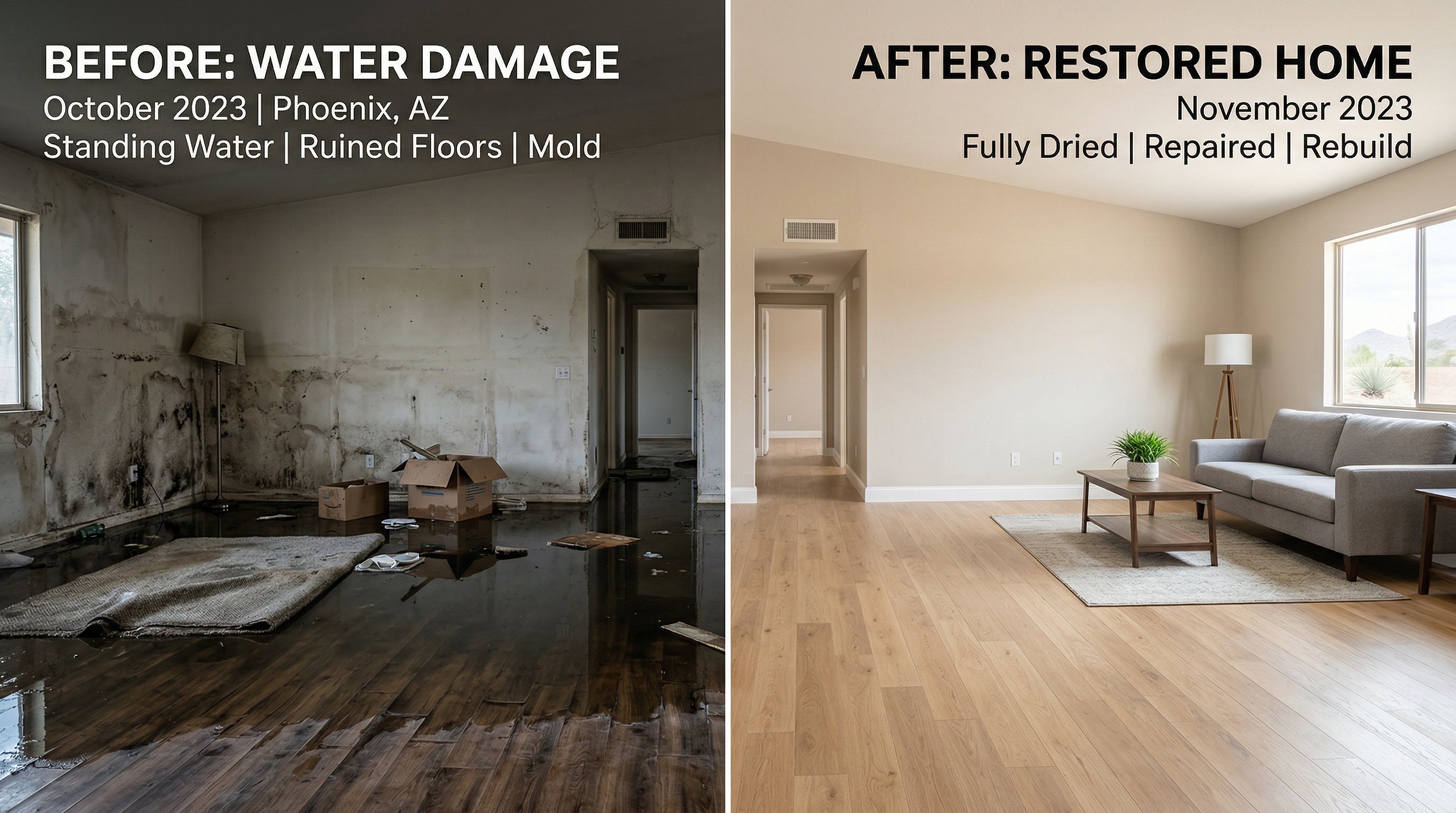
Water damage restoration is the comprehensive process of returning a property to its pre-loss condition after water damage has occurred. Where mitigation is about stopping the damage, restoration is about repairing it. Restoration is a more extensive, longer-term process that follows mitigation.
Using the emergency room analogy: if mitigation is stabilizing the patient, restoration is the surgery, recovery, and physical therapy that returns them to full health.
What Does Water Damage Restoration Include?
The full scope of water damage restoration encompasses:
- Structural drying: The continued and systematic drying of all affected structural components — walls, floors, ceilings, framing — until they reach their pre-loss moisture content levels. This phase can take 3 to 5 days or more depending on the severity of saturation.
- Demolition of unsalvageable materials: Removing drywall, insulation, flooring, and other materials that were too saturated to be dried in place. This is sometimes called "flood cuts" — horizontal cuts in drywall just above the water line to remove saturated sections while leaving dry sections intact.
- Mold remediation: If mold has developed as a result of the water damage — or if conditions are such that mold risk is elevated — professional remediation is performed to address existing growth and prevent recurrence.
- Structural repairs: Replacing removed drywall, flooring, insulation, and other building materials with new materials to restore the structure.
- Finishing work: Painting, trim work, tile installation, cabinetry reinstallation, and other finishing tasks that return the space to its pre-loss appearance.
- Content restoration: Cleaning, deodorizing, and restoring personal property and furnishings where possible.
Full water damage restoration returns your Phoenix home to the condition it was in before the water damage occurred.
The Key Differences Between Mitigation and Restoration
Understanding the distinctions helps clarify what you're being quoted for and what to expect at each stage of your recovery.
Timing
Mitigation is immediate — it begins the moment a restoration team arrives and focuses on the first hours and days after the water event. Restoration follows mitigation and may begin once the structure is stabilized and the full scope of damage is assessed. In practice, the transition between mitigation and restoration is often gradual rather than a hard line.
Goal
The goal of mitigation is to prevent further damage. The goal of restoration is to repair existing damage. Mitigation preserves the situation; restoration improves it.
Duration
Mitigation is typically completed within the first 1 to 3 days of an emergency response. Restoration timelines vary widely — from a few days for minor damage to several weeks or months for extensive structural damage. Read our blog on what to do immediately after water damage in Phoenix for guidance on the earliest steps.
Cost
Mitigation costs are typically lower than restoration costs because they involve labor and equipment rather than construction materials. However, both phases are typically covered under standard homeowner's insurance policies for covered losses. The cost of each phase is documented separately in the claim, which is why understanding the distinction matters for insurance purposes.
Personnel
Mitigation work is performed by trained water damage technicians. Restoration work may involve technicians, mold remediation specialists, general contractors, and specialty trade workers (flooring, painting, drywall, tile) depending on what needs to be repaired or replaced.
Why Insurance Companies Distinguish Between the Two
Insurance carriers separate mitigation and restoration in their coverage frameworks because they involve different types of work, different timelines, and different cost structures. Your adjuster will typically request separate documentation for each phase:
- Mitigation documentation includes moisture readings, equipment logs, extraction records, and photographs of initial damage.
- Restoration documentation includes scope-of-work estimates, materials lists, before-and-after photographs, and contractor invoices.
When you work with Phoenix Water Damage Restoration, we document both phases thoroughly to support your insurance claim. For more general guidance on insurance coverage, see our blog post on whether insurance covers water damage in Phoenix, AZ.
Water Damage Remediation: A Third Term to Know
You may also encounter the term "water damage remediation," which is sometimes used as a synonym for restoration, though it more specifically refers to addressing contamination or hazardous conditions resulting from water damage. Remediation typically refers to:
- Mold remediation — identifying, containing, and removing mold growth
- Contaminated water cleanup — addressing Category 2 (gray water) and Category 3 (black water/sewage) damage
- Odor elimination following sewage or mold-affected water damage
Remediation may occur as part of the restoration phase or may be a separate service required before restoration can proceed. Our water damage remediation services in Phoenix address all types of contamination resulting from water intrusion.
Do You Always Need Both Mitigation and Restoration?
Not always — but often yes. The determining factor is whether the water damage caused any lasting damage to materials that require repair or replacement.
When Mitigation Alone May Be Sufficient
If water damage is caught extremely early — within the first hour or two — and involves clean water (Category 1) that has only affected easily dried materials (like sealed tile floor), it may be possible to mitigate and dry the property without any structural removal or repair. However, this scenario is the exception rather than the rule.
When Both Are Required
In the majority of Phoenix water damage cases, both phases are necessary. Any time water has:
- Been present for more than a few hours
- Affected drywall, insulation, carpet, wood flooring, or wood framing
- Originated from a contaminated source (gray or black water)
- Caused visible staining, swelling, or warping of materials
- Created conditions where mold may have developed
...restoration work will follow mitigation to bring the property back to pre-loss condition.
What Phoenix Homeowners Should Ask Their Restoration Company
When calling a water damage company in Phoenix, AZ, there are several important questions to ask upfront:
- Are you providing mitigation services, restoration services, or both? Some companies specialize in one phase. Full-service companies handle both, which simplifies the process and accountability chain.
- Will you document the drying process for my insurance claim? Daily moisture logs and drying reports are essential for insurance documentation.
- Can you provide a scope of work estimate for both phases separately? This helps your insurance adjuster process the claim efficiently.
- Are you licensed and certified in Arizona? Look for IICRC-certified technicians (Institute of Inspection, Cleaning and Restoration Certification) as a benchmark for professional standards.
- Do you work directly with insurance adjusters? Companies with insurance claim experience can significantly streamline the reimbursement process.
Mitigation and Restoration for Specific Phoenix Water Damage Scenarios
Burst Pipe in Phoenix Home
Mitigation: Shut off water supply, extract standing water, document damage, deploy drying equipment. Restoration: Dry structure to pre-loss moisture levels, remove and replace saturated drywall and insulation, repair or replace flooring, repaint. See our burst pipe restoration service for more.
Monsoon Flooding Through Foundation or Windows
Mitigation: Extract flood water, remove contaminated materials in contact with storm water, deploy drying equipment, apply antimicrobials. Restoration: Replace removed materials, address any structural damage, inspect for and remediate any mold development.
Sewage Backup
Mitigation: Contain and extract contaminated black water with full personal protective equipment, remove all materials in direct contact with sewage, apply industrial antimicrobial treatment. Restoration: Replace all removed materials, test for contamination clearance, restore finished surfaces. Our sewage backup cleanup service handles both phases for Phoenix homeowners.
Appliance Leak
Mitigation: Stop water flow, extract standing water, assess extent of moisture migration. Restoration: Dry affected area, address flooring and cabinet damage as needed.
Frequently Asked Questions: Water Damage Restoration vs. Mitigation
Does my homeowner's insurance cover both mitigation and restoration?
Most standard Arizona homeowner's insurance policies cover both phases for sudden and accidental covered water losses. Coverage for mitigation may be listed under "additional living expenses" or "property damage" depending on your policy. Review your policy and contact your insurer promptly. For more detailed guidance, read our blog post on insurance coverage for water damage in Phoenix.
Can I start the restoration phase before mitigation is fully complete?
No. Attempting restoration work before the structure is fully dry leads to mold problems and recurring damage. Mitigation must be complete — confirmed through professional moisture testing — before reconstruction begins. Rushing this sequence is one of the most common and costly mistakes in water damage recovery.
How long does water mitigation typically take in Phoenix?
Emergency mitigation — water extraction and initial equipment deployment — is typically completed within the first 24 hours of our arrival. The drying phase of mitigation takes 3 to 5 days on average before clearance readings confirm the structure is dry.
What is the difference between a mitigation company and a restoration company?
Some companies specialize in one phase. Phoenix Water Damage Restoration is a full-service company that handles both phases — from emergency response and extraction through complete structural repair and finishing work. This single-source approach is more efficient and eliminates the coordination challenges of working with separate contractors.
How do I know if I need mold remediation in addition to restoration?
If water damage was present for more than 24 to 48 hours before being addressed, or if you detect musty odors after restoration, mold assessment is recommended. Our mold risk assessments identify whether remediation is necessary before restoration work proceeds.
One Call for Both Phases in Phoenix, AZ
Whether you need emergency water mitigation, full restoration, or a combination of both, Phoenix Water Damage Restoration provides comprehensive services from the first emergency call through the final coat of paint. We handle documentation, insurance coordination, and every phase of the restoration process so you can focus on getting your life back to normal.
Phoenix Water Damage Restoration is a trusted choice for commercial & residential water damage restoration in Phoenix, AZ, delivering fast response times, expert drying, and full-service restoration.
Call Us 24/7: (623) 300-3108
Easy steps to create a color palette
Lorem ipsum dolor sit amet, consectetur adipiscing elit lobortis arcu enim urna adipiscing praesent velit viverra sit semper lorem eu cursus vel hendrerit elementum morbi curabitur etiam nibh justo, lorem aliquet donec sed sit mi dignissim at ante massa mattis.
- Neque sodales ut etiam sit amet nisl purus non tellus orci ac auctor
- Adipiscing elit ut aliquam purus sit amet viverra suspendisse potent
- Mauris commodo quis imperdiet massa tincidunt nunc pulvinar
- Excepteur sint occaecat cupidatat non proident sunt in culpa qui officia
What is a color palette?
Vitae congue eu consequat ac felis placerat vestibulum lectus mauris ultrices cursus sit amet dictum sit amet justo donec enim diam porttitor lacus luctus accumsan tortor posuere praesent tristique magna sit amet purus gravida quis blandit turpis.

Don’t overspend on growth marketing without good retention rates
At risus viverra adipiscing at in tellus integer feugiat nisl pretium fusce id velit ut tortor sagittis orci a scelerisque purus semper eget at lectus urna duis convallis porta nibh venenatis cras sed felis eget neque laoreet suspendisse interdum consectetur libero id faucibus nisl donec pretium vulputate sapien nec sagittis aliquam nunc lobortis mattis aliquam faucibus purus in.
- Neque sodales ut etiam sit amet nisl purus non tellus orci ac auctor
- Adipiscing elit ut aliquam purus sit amet viverra suspendisse potenti
- Mauris commodo quis imperdiet massa tincidunt nunc pulvinar
- Adipiscing elit ut aliquam purus sit amet viverra suspendisse potenti
What’s the ideal customer retention rate?
Nisi quis eleifend quam adipiscing vitae aliquet bibendum enim facilisis gravida neque euismod in pellentesque massa placerat volutpat lacus laoreet non curabitur gravida odio aenean sed adipiscing diam donec adipiscing tristique risus amet est placerat in egestas erat.
“Lorem ipsum dolor sit amet consectetur adipiscing elit, sed do eiusmod tempor incididunt ut labore et dolore magna aliqua enim ad minim veniam.”
Next steps to increase your customer retention
Eget lorem dolor sed viverra ipsum nunc aliquet bibendum felis donec et odio pellentesque diam volutpat commodo sed egestas aliquam sem fringilla ut morbi tincidunt augue interdum velit euismod eu tincidunt tortor aliquam nulla facilisi aenean sed adipiscing diam donec adipiscing ut lectus arcu bibendum at varius vel pharetra nibh venenatis cras sed felis eget.