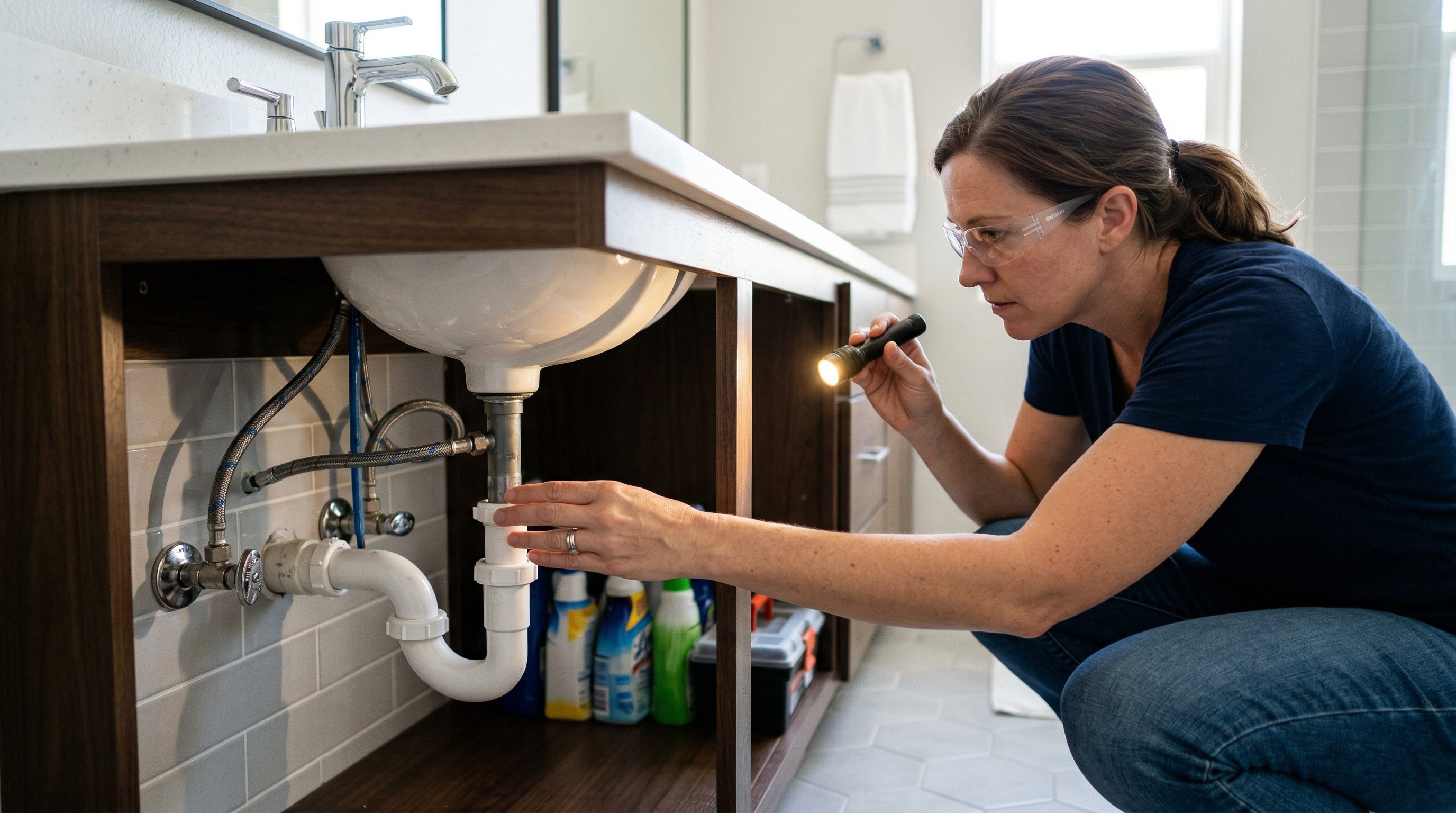

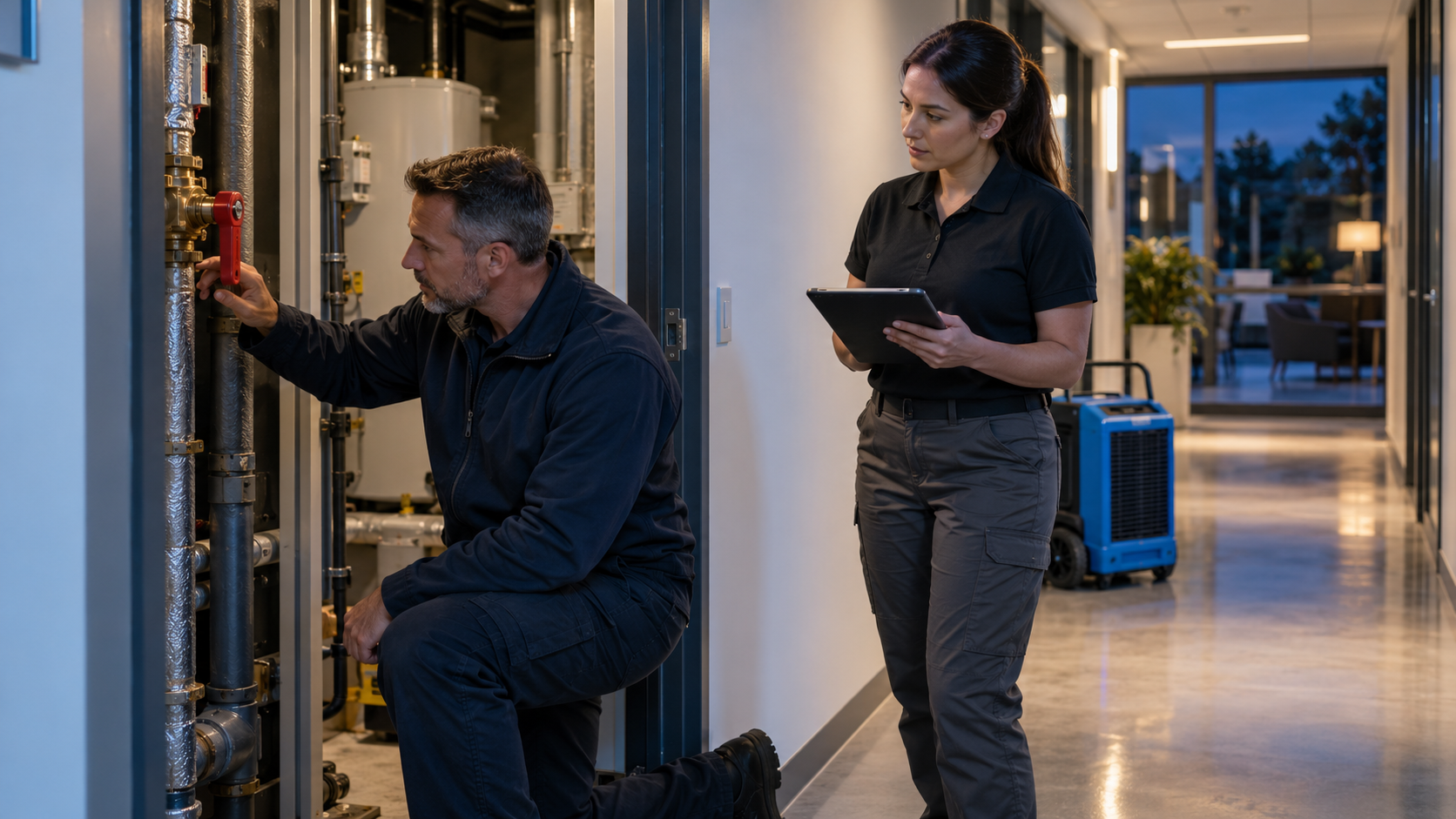
A commercial plumbing emergency rarely stays confined to a pipe. An overnight leak can affect tenant access, electrical systems, stock, office equipment, customer appointments, and the decision to open the building the next morning. The maintenance team may solve the source problem while the property manager still needs to establish which areas are safe and usable.
A practical incident plan connects emergency plumbing, restoration, and business continuity. It gives each professional a defined task and keeps reopening decisions based on actual conditions. The following approach is designed for building owners, facility managers, and small-business operators who need to manage a water loss without confusing a repaired pipe with a restored property.
Establish one person who coordinates the incident
After-hours incidents become harder when several people call different contractors and each provides a different account of the problem. Designate one owner or manager contact to coordinate information, access, and authorization. That person does not replace technical judgment. Their job is to keep the response organized and make sure the appropriate decision-maker receives each update.
Start a short incident log. Record the discovery time, affected rooms, whether water is still releasing, and any visible hazards. Note the people contacted and the instructions received. Separate observations from assumptions: a wet ceiling is an observation; a guess about a broken pipe above it is a hypothesis until the source is confirmed.
Make the coordinator's contact details available to the plumber, restoration team, building owner, and relevant tenants. If the first coordinator must leave, document the handover. A named replacement and a concise status update prevent the next shift from reopening an isolated area or restarting a fixture before the responsible professional has cleared it.
Protect people before protecting the operating schedule
Keep staff, customers, and visitors away from standing water, affected electrical equipment, sewage, or a sagging ceiling. Block access with a clear temporary arrangement and communicate the restriction. Do not assume that a shallow puddle is safe because employees can step around it. The source and nearby building systems still need assessment.
Do not enter water to reach a breaker panel or move powered equipment. Electrical isolation can require an electrician or utility involvement. If a known water valve is accessible from a safe, dry location, an authorized person may be able to limit further release. Never disable a fire-protection system as an improvised plumbing solution; that requires appropriate specialist coordination.
If there is immediate danger, suspected structural instability, or a gas leak, leave and contact emergency services or the appropriate utility. The first operational decision may be a temporary closure. That can be inconvenient, but a schedule should not override an unresolved hazard. Record the reason for the restriction and who will assess it.
Give the emergency plumber useful information
The initial call should identify the building address, access arrangements, approximate location of the release, and whether water isolation has occurred. Mention the type of premises and any systems that might be connected to the affected supply. In a multi-tenant building, note whether adjacent units, common areas, or rooms below are involved.
Ask whether the provider can handle the suspected system and reach the property. Information from a 24/7 emergency plumber can help illustrate the questions to ask about after-hours availability and response. Confirm actual service coverage, qualifications, and commercial scope for the provider you engage; an emergency service label alone does not establish that fit.
Clarify whether the immediate work will be stabilization or a completed repair. Ask what testing is planned and what restrictions remain. The incident coordinator needs to know which supply sections or fixtures can return to use and which must remain isolated. That information should be passed to occupants in plain language, with a time for the next update.
Bring restoration into the response before the area looks finished
A repaired connection stops new water from entering the building, but it does not show what moisture remains in walls, flooring, ceiling spaces, or contents. A restoration assessment can identify the affected area, contamination concerns, and the drying or removal needed. In some incidents, assessment starts while the plumbing repair is still being completed.
Provide the restoration team with the source information available from the plumber. Give them a floor plan or a simple description of adjoining spaces. Mention storage rooms, raised flooring, built-in cabinetry, and sensitive equipment. Water can travel beyond the room where it was discovered, so the assessment should follow plausible paths rather than stop at a tenant boundary.
Ask the two teams to identify the handoff conditions. Has the source been controlled? Is the repair temporary? Does testing require water to be restored? What areas need access for drying? These questions reduce the chance that one contractor closes an opening while another still needs it or that a retest adds water to an area already under mitigation.
Build the drying scope around the actual materials
Commercial premises may contain a mix of finishes, floor assemblies, partitions, fixtures, and stored goods. They do not all respond to water in the same way. Ask what materials are confirmed affected, which areas remain under investigation, and how those findings will guide removal or drying. A broad statement that the building needs fans is not a complete scope.
Monitoring should record the relevant locations and materials, together with appropriate moisture or humidity observations. Ask how progress will be assessed and what conditions must be met before repair work begins. A dry-looking carpet surface or wall finish is not enough to establish that the underlying assembly is ready to close.
Plan the placement of equipment and any containment around safe access and the restoration method. Do not relocate equipment to make room for an appointment without discussing it with the team. If part of the premises must remain operational, ask whether the unaffected area can be separated safely and whether that arrangement changes as work progresses.
Keep contamination decisions distinct from routine housekeeping
Staff should not be asked to mop an unknown loss as if it were a spilled drink. Water associated with sewage or other contamination requires a suitable cleanup approach. Keep clean stock and equipment away from the affected zone, and ask the restoration professional what handling restrictions apply. Avoid moving damp items through occupied spaces without a plan.
The EPA's cleanup guidance advises experienced professional assistance for sewage or other contaminated-water damage and emphasizes resolving leaks and drying affected materials. For a commercial property, those are starting principles. They do not substitute for a specific assessment of the source, building conditions, and any relevant occupational requirements.
If mold is present or suspected, discuss it before opening walls or changing airflow. The CDC's mold cleanup recommendations identify groups who should not take part in cleanup, including people with certain respiratory conditions or immune suppression. Managers should arrange appropriate professional advice and accommodations rather than asking employees to judge their own exposure during an improvised cleanup.
Protect records and assets without creating a second incident
Where access is safe and permitted, document affected stock, furnishings, and equipment before moving them. Take wider photographs that show the room and closer views that show individual items. Keep an inventory with locations and condition notes. Do not energize damp equipment to test whether it still works; seek appropriate specialist evaluation.
Set aside a clean staging area for items that can be handled safely. Keep damaged or potentially contaminated materials separate. Ask who will authorize disposal and what documentation is needed. The owner, tenant, insurer, and restoration contractor may have different roles in that decision, so establish responsibility before a skip or disposal container arrives.
Back up the incident log and contractor records using the business's normal secure process. Avoid putting customer or employee information into public photographs or informal messages. The purpose is to document the building loss, not to circulate sensitive records that happen to be visible on desks, screens, or paperwork within the affected rooms.
Use a written checklist before reopening
Reopening should answer several questions. Is the plumbing source controlled and tested? Have electrical concerns been assessed? Are the proposed occupied areas accessible and suitable for use? Does restoration still require isolation, equipment, or restricted areas? Are any local authority, landlord, or specialist requirements relevant to the premises?
Obtain the necessary decisions from the responsible professionals rather than asking the incident coordinator to certify technical conditions. Record which areas may open, which remain closed, and what restrictions apply. In a phased return, employees and tenants need a clear boundary and a method for reporting a new symptom or accidental equipment disruption.
Communicate operational changes without overpromising. Tell customers about the services available and any access limitations. Avoid announcing that everything is fully restored while drying or repair remains underway. A realistic reopening message reduces confusion for both visitors and the teams still working in the building.
Preserve the distinction between restoration and capital improvements
A water loss can expose aging finishes or prompt a tenant to rethink a layout. Separate those improvement choices from the emergency response. A reconstruction scope should identify the damaged components being repaired and any optional alterations. Otherwise, cost and schedule discussions can become unclear just when multiple parties need the same information.
Check the insurer's reporting and authorization instructions if a claim may be involved. Coverage and payment depend on the policy and circumstances; a contractor's presence does not guarantee reimbursement. Retain invoices, photographs, repair notes, and drying records. Discuss evidence needs before removal or disposal, while continuing any urgent work necessary for safety and mitigation.
Schedule each trade around the next verified checkpoint. Closing partitions, reinstalling cabinetry, replacing flooring, and reconnecting equipment should follow the appropriate assessment and testing. Ask for a list of remaining work at handover so small unfinished items do not disappear between the restoration team and the business reopening process.
Turn the incident into a stronger after-hours plan
After the property returns to service, review what slowed the response. Was the valve location known? Could the contractor access the building? Who had authority to approve urgent work? Was the contact list available after hours? Resolve those practical gaps while the experience is fresh, and update the plan when tenants or key staff change.
Arrange suitable inspection and maintenance for the system involved in the loss. Discuss recurring concerns with a qualified professional rather than assigning an arbitrary replacement schedule. Leak monitoring may be useful in selected spaces, but the building needs a clear process for receiving alerts and acting on them. An unmonitored sensor does not provide an effective response plan.
Coordinate the repair, drying, and return to work
A commercial plumbing emergency becomes manageable when source control, restoration, and operating decisions share the same facts. Establish one coordinator, give each trade a defined responsibility, and reopen according to assessed conditions. That approach helps the business avoid treating a stopped leak as the end of the incident.
Phoenix Water Damage Restoration provides commercial water damage restoration and structural drying. Discuss the affected spaces, source status, and operating constraints when arranging an assessment. The goal is a clear path from urgent plumbing repair to a property that can return to use with the remaining work understood.
Easy steps to create a color palette
Lorem ipsum dolor sit amet, consectetur adipiscing elit lobortis arcu enim urna adipiscing praesent velit viverra sit semper lorem eu cursus vel hendrerit elementum morbi curabitur etiam nibh justo, lorem aliquet donec sed sit mi dignissim at ante massa mattis.
- Neque sodales ut etiam sit amet nisl purus non tellus orci ac auctor
- Adipiscing elit ut aliquam purus sit amet viverra suspendisse potent
- Mauris commodo quis imperdiet massa tincidunt nunc pulvinar
- Excepteur sint occaecat cupidatat non proident sunt in culpa qui officia
What is a color palette?
Vitae congue eu consequat ac felis placerat vestibulum lectus mauris ultrices cursus sit amet dictum sit amet justo donec enim diam porttitor lacus luctus accumsan tortor posuere praesent tristique magna sit amet purus gravida quis blandit turpis.

Don’t overspend on growth marketing without good retention rates
At risus viverra adipiscing at in tellus integer feugiat nisl pretium fusce id velit ut tortor sagittis orci a scelerisque purus semper eget at lectus urna duis convallis porta nibh venenatis cras sed felis eget neque laoreet suspendisse interdum consectetur libero id faucibus nisl donec pretium vulputate sapien nec sagittis aliquam nunc lobortis mattis aliquam faucibus purus in.
- Neque sodales ut etiam sit amet nisl purus non tellus orci ac auctor
- Adipiscing elit ut aliquam purus sit amet viverra suspendisse potenti
- Mauris commodo quis imperdiet massa tincidunt nunc pulvinar
- Adipiscing elit ut aliquam purus sit amet viverra suspendisse potenti
What’s the ideal customer retention rate?
Nisi quis eleifend quam adipiscing vitae aliquet bibendum enim facilisis gravida neque euismod in pellentesque massa placerat volutpat lacus laoreet non curabitur gravida odio aenean sed adipiscing diam donec adipiscing tristique risus amet est placerat in egestas erat.
“Lorem ipsum dolor sit amet consectetur adipiscing elit, sed do eiusmod tempor incididunt ut labore et dolore magna aliqua enim ad minim veniam.”
Next steps to increase your customer retention
Eget lorem dolor sed viverra ipsum nunc aliquet bibendum felis donec et odio pellentesque diam volutpat commodo sed egestas aliquam sem fringilla ut morbi tincidunt augue interdum velit euismod eu tincidunt tortor aliquam nulla facilisi aenean sed adipiscing diam donec adipiscing ut lectus arcu bibendum at varius vel pharetra nibh venenatis cras sed felis eget.